While just 11 days have passed since the MLB deadline, quite a lot has changed for the Toronto Blue Jays. Mainstays like Kevin Gausman and Daulton Varsho are gone; the team has gone 7-4 to put them back in the vicinity of the playoff race, and the club has some notable new faces.
It’s too early to know exactly what the players Toronto added at the deadline will offer to the team in the long-term, but enough time has passed to examine the first impressions the newest Blue Jays are making as the team continues its surprising mid-August roll.
Soriano was the Blue Jays' most consequential in-season acquisition, and he’s acquitted himself relatively well in two starts with just two earned runs allowed over 10.2 innings. That bottom-line production hasn’t come with the most impressive underlying numbers, as walks have remained an issue; he hasn’t struck out more than four hitters in either of his starts with Toronto, and pitch inefficiency — along with suspect defence — caused him to last just 4.2 frames in his Blue Jays debut.
The 27-year-old hasn’t arrived with his new team and instantaneously become an entirely new and more effective pitcher, but that’s not a fair expectation. It’s noteworthy that he’s coming from an organization that just fired its pitching coaches to a club with a good reputation for getting the most out of veteran arms, but any gains Soriano gets from a better developmental environment could take time to manifest. The same goes for the step up in the framing and defence around him.
What his early outings do reveal is that Toronto may want him to lean on his sinker as opposed to his four-seam fastball in a Blue Jays uniform.
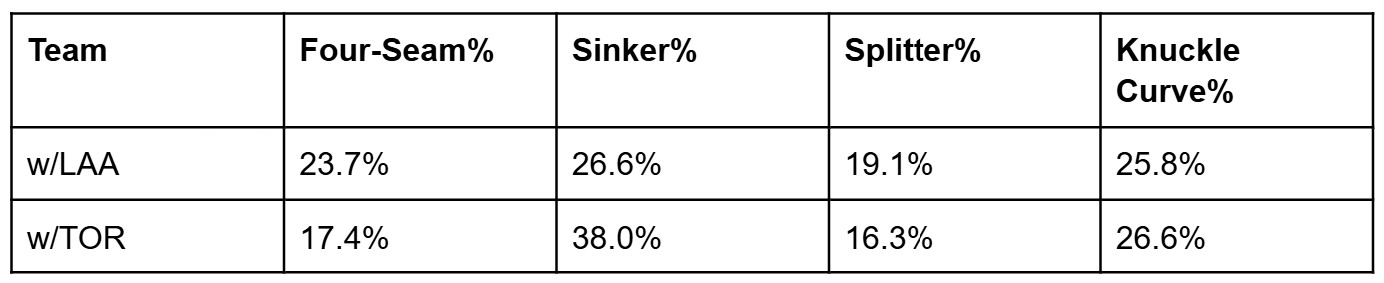
It’s not enough of a difference to be definitive, but Soriano’s sinker rate on Wednesday (47.8 percent) was his highest in any game this season. In 2024 and 2025, the right-hander was MLB’s top groundball pitcher, the Blue Jays may think he’s at his best when he’s in that mode as opposed to working at the top of the zone with the four-seamer and chasing strikeouts. Soriano is talented enough to do both and has a 3.16 ERA, 9.02 K/9, and 51.4 percent groundball rate to show for it this season — all well above-average numbers. That said, early indications from his Toronto tenure suggest that he may be chasing grounders more with the Blue Jays than he did with the Los Angeles Angels, even if his groundball rate in the small sample of two starts (46.7 percent) doesn’t jump off the page.
Bateman came to the Blue Jays with a reputation for being a fast, contact-oriented hitter who could chase down baseballs in the outfield and swipe a few bases. For the most part, he’s lived up to that reputation.
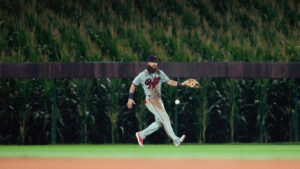
The 24-year-old’s speed has been apparent, even if he has yet to record a stolen base with the Blue Jays. Statcast has him at 28.8 feet per second — in the 88th percentile league-wide. Perhaps the best example of his top-end wheels came in one of his two games with the Buffalo Bisons.
Bateman appears to be an early fan favourite among Blue Jays’ fans, and has earned manager John Schneider’s trust almost immediately. After hitting ninth in his MLB debut, he’s slotted in first or second in the order in each game since. Some of that has to do with a lack of appealing alternatives for a team that’s struggled mightily offensively, but Bateman deserves credit for putting together consistently competent at-bats and a few timely hits — even if his overall line of .259/310/.333 is hardly world-beating.
The most surprising thing Bateman has done so far is show aggression in the batter's box. FanGraphs’ scouting report of the outfielder in May described him as one of the most “patient, thumb-twiddling hitters in the minors” and before arriving in the majors, his 17.3 percent walk rate ranked fourth among qualified hitters in the International League. In his six MLB games, his swing rate (46.8 percent) is well above what he showed with the Chicago Cubs’ Triple-A affiliate (36.9 percent), and he’s walked twice in 29 plate appearances.
It remains to be seen if Bateman is actually changing his approach, but it will be something to follow carefully in the weeks to come. The rookie created a great deal of offensive value in the minors by drawing walks, but that will be harder to do in the majors, where pitchers have better control. He also lacks the power threat to force pitchers to nibble, so he can expect a heavy dose of pitches in the zone. Whether he can convert those pitches into a steady stream of hits or sees his walk rate fall without creating other value in its place will help determine how his offensive profile works at the game’s highest level.
Smith doesn’t project to be nearly as impactful as Soriano, and he’s not a fresh face like Bateman, but his early work in a Blue Jays uniform is representative of the utility he provides.
In 10 games with Toronto, Smith has played three positions (3B, 2B, and LF), pinch hit twice, pinch run once, hit a home run, and stolen a base. His overall wRC+ (95) closely matches his career average (94), even if it falls a bit short of his standard from 2024 and 2025 (107) when he took 1,155 plate appearances for the Texas Rangers and produced 4.7 fWAR.
Smith’s 2026 has been a nightmare due to a combination of injuries, illness and poor performance, and it's unclear if Toronto will see the best of him this year, but the early returns are solid. Stylistically, it hasn’t been a particularly impressive run as 14 of Smith’s 21 plate appearances have ended in a strikeout or a groundball, and his approach has been ugly at times with a high chase rate (37.2 percent) and a low swing rate on balls in the zone (53.7 percent). That’s relatively easy to dismiss as small-sample noise for a player who’s produced above-average walk and strikeout rates (9.5 percent and 20.0 percent) over 1,815 MLB plate appearances. Chances are, Smith hasn’t completely lost his strike-zone judgment. Even when he struggled with the Rangers earlier this season, quality of contact was the biggest issue, with his walk and strikeout rates staying close to his career averages.
Nothing Smith has done so far is likely to get the fans or organization particularly excited, but even the best version of the veteran is quietly effective, and that description fits his early play.




 4:28
4:28